.webp)
Building trust through onboarding
KYC onboarding is inherently complex. Clients must provide detailed personal or institutional information along with supporting documentation.
The goal was to design a system that:
The goal was to design a system that:
- Builds trust from the first interaction
- Makes regulatory requirements feel manageable
- Supports both institutional clients and accredited investors
- Allows onboarding to happen over multiple sessions
- Enables administrators to review and approve submissions efficiently
%20(1).webp)
My Role
As the lead designer, I worked closely with engineering and sales to translate compliance requirements and client needs into a structured onboarding experience for both clients and administrators.
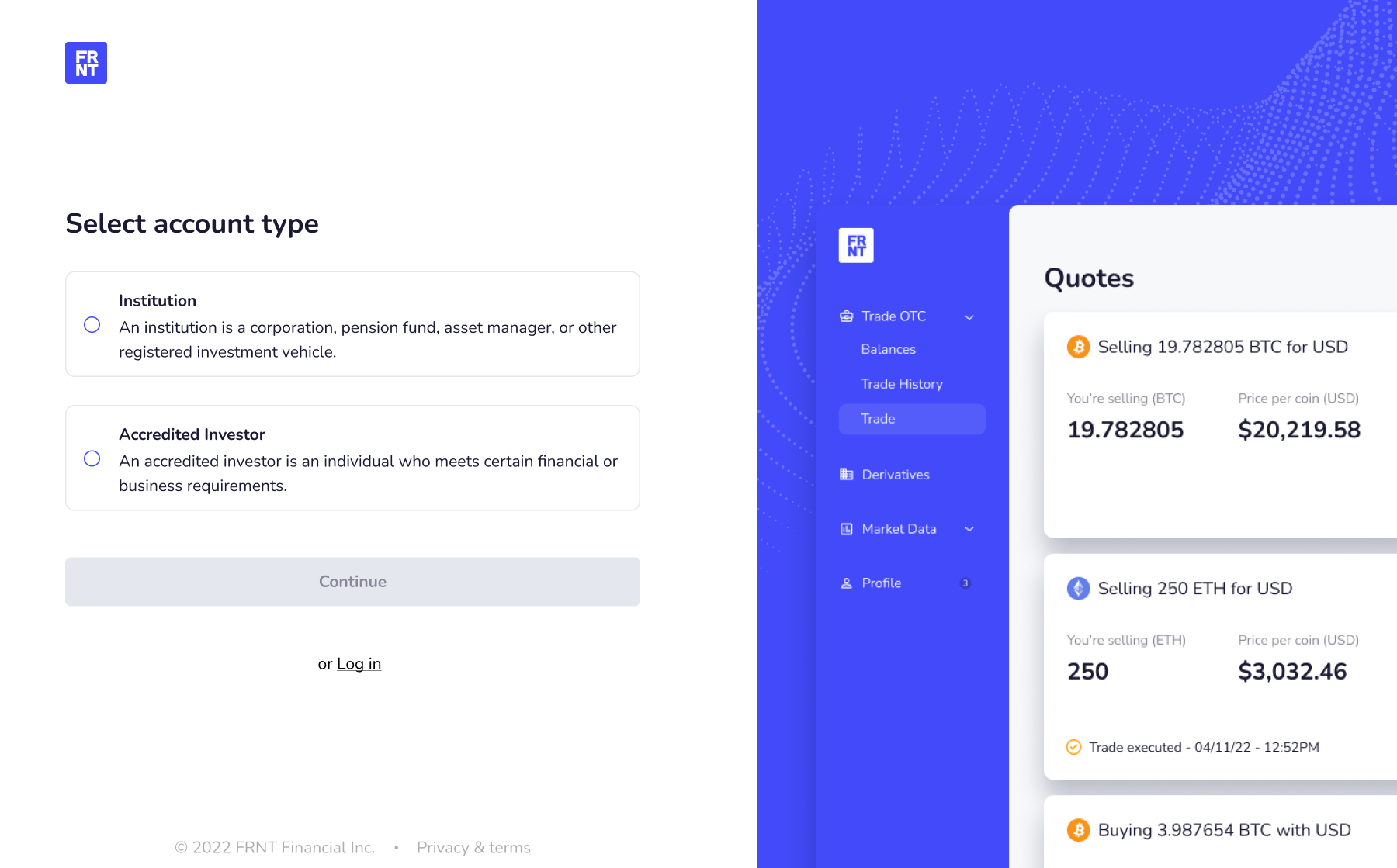
Supporting two distinct client types
FRNT works with two different client types with unique compliance requirements. The onbaording system begins by identifying the client type and dynamically adjusts the flow so users oonly see fields relevant to them.
.webp)
Designing for trust and security
FRNT operates in a market where clients expect high levels of security and professionalism. I designed the account creation process to include two-factor authentication and email verification, signaling trust from the first interaction.

Desktop first design
Most FRNT clients are institutions or high-net-worth individuals who typically complete onboarding during professional workflows on desktop environments.Designing for desktop allowed us to prioritize clarity, document handling, and multi-section navigation.

Desinging for both clients and admin
The onboarding platform needed to be desgined to meet the needs of both clients and FRNT's internal compliance team. We weren't ready to do a full redesign of the internal system, so we updated the existing system to work with the new client portal.
The system was designed so both sides of the workflow operated together:
The system was designed so both sides of the workflow operated together:
- Clients submit required information and documentation
- Admins review submissions in real time
- Admins add internal documentation where needed
- The onboarding is approved once all requirements are met
.webp)
Making a complex process feel manageable
KYC onboarding requires a significant amount of information and documentation. Clients often need time to gather documents or confirm details before completing the process.
To make the experience manageable, I structured the onboarding into clear sections so clients could complete it step by step. Progress is saved automatically, allowing users to leave and return later without losing their work.
I also implemented a breadcrumb-style progress tracker so clients can easily see what steps are complete and what remains. This visibility helps reduce uncertainty and keeps users moving through the onboarding process.
To make the experience manageable, I structured the onboarding into clear sections so clients could complete it step by step. Progress is saved automatically, allowing users to leave and return later without losing their work.
I also implemented a breadcrumb-style progress tracker so clients can easily see what steps are complete and what remains. This visibility helps reduce uncertainty and keeps users moving through the onboarding process.
%20(1).webp)
Designing Form Components
The platform required several form interactions, including address entry, date selection, and document uploads. I designed consistent input patterns and validation states to keep the experience clear and predictable.
.webp)
Guiding Users Through Complex Requirements
I designed each KYC requirement with a short explanation of what information or document was needed, reducing ambiguity and helping prevent incorrect submissions. This approach saves time for both the client and FRNT during review while keeping the interface clear and easy to scan.
.webp)
Outcome
The onboarding platform became a core operational tool for FRNT.
Without a successful onboarding process, the company cannot establish client relationships or conduct business. By structuring a complex regulatory process into a clear, trustworthy, and manageable experience, the platform enables FRNT to onboard clients efficiently while maintaining compliance standards.
Without a successful onboarding process, the company cannot establish client relationships or conduct business. By structuring a complex regulatory process into a clear, trustworthy, and manageable experience, the platform enables FRNT to onboard clients efficiently while maintaining compliance standards.